
The 50 Climate Leaders initiative highlights companies committed to sustainable business practices and climate protection. Fackelmann Brands is proud to be part of this initiative, actively supporting the 17 UN Sustainable Development Goals.
Come with us on a journey into a greener future.
Sustainable action has always been a fundamental part of our philosophy. Many of our nearly 10,000 products are already designed for long-term use. We have lived by the principle of sustainability since our foundation almost 100 years ago: Heinrich Fackelmann laid the groundwork in 1919 with the first wooden kitchen gadgets. Our goal: By 2025, we aim to convert a large share of our products and packaging to sustainable materials. To stay focused on this path, we build on three core pillars that form the basis of all our activities:
Deeply rooted in Germany and at home all over the world: This applies equally to our products and their manufacture. At our headquarters in Hersbruck and Aichach in Bavaria, we set the highest standards in our production and on the most closed energy and recyclable material cycles: The wood waste from furniture production in Hersbruck is burned in a biomass boiler and used to heat the entire site. The waste heat from plastics production is used in a heat recovery system to heat the service water. We also use photovoltaic systems in Aichach and Hersbruck to generate solar power.
At our production sites around the world, we attach great importance to using the appropriate measures. The Hersbruck location has been climate-neutral since 2020, with further locations to follow. We produce 6,387 tons of CO2 a year, which we offset accordingly. This also includes transport routes from products to the customer and back to us and, for example, business trips.
As a manufacturer, we want our products to be as durable, resource- and energy-efficient as possible, as well as repair-friendly and recyclable. We always want to manufacture products for a long service life and pursue the ideal of circular economy. That is why we rely on materials without complex composition and easy to use. In order to reduce the consumption of fossil raw materials, we are initially focusing on converting many materials to materials that are completely or at least partially made from renewable or recycled raw materials. Our goal is to offer the most competent range of sustainable products in Europe. We started our development over 10 years ago with the so-called "greens", kitchen gadgets made of plastic.
Today we use PE made from renewable raw materials and FSC ™ certified wood for our “Ecolution” series. We are currently working on completely avoiding the use of feed plants for sustainable materials. We are also taking the first steps with baking molds: With our “Green Vision” baking molds, the wax from the Brazilian carnauba palm is being used for coatings for the first time.
Of course for us: As a family company, the company family is particularly important. Compliance with social standards and optimal working conditions for employees as well as creating a positive working atmosphere are the focus in Germany and at our more than 40 company locations around the world. These standards are certified and approved both by detailed internal audit systems and by higher-level regulations such as the BSCI. At our headquarters in Hersbruck and Aichach, in particular, we benefit from above-average years of service - our employees have been with the company for around 14 years on average - but attach just as much importance to a balanced mix. 30% of our employees at the headquarters in Hersbruck are under 30 years of age, the average age is 42 years. In individual employee appraisals and regular feedback rounds, we jointly evaluate possible areas of development in order to continuously develop. We also support the “By bike to work” initiative, subsidize the use of public transport and promote company health management with various sports and preventive measures such as yoga, Nordic walking and running courses, lectures on topics such as healthy sleep or non-smoking, health days or Pedometer Actions.
If a textile article has been awarded the STANDARD 100 label, all components of the article have been tested for harmful substances and are therefore harmless.
International Sustainability and Carbon Certification (ISCC), based in Cologne, is a certification system that distinguishes agricultural raw materials in Germany, the EU and third countries that comply with the sustainability regulations for bioenergy
The 50 Sustainability and Climate Pioneers project is the international economy’s response to the climate challenges of our time: it shows how climate change can be combated actively and efficiently.
Companies inevitably cause CO2 emissions, even if sustainable management is already taken into account in many areas. As part of the climate-neutral company, all emissions are recorded and continuously assessed. All other unavoidable emissions can be offset through climate protection projects.
The MAXIMIZING GREEN standard in connection with the ILAG coating fulfills central requirements for environmental and health protection. Only raw materials that reduce the ecological footprint are used for this product range - and not only in the coating itself, but also in the entire value chain.
Our Green Vision baking molds are climate neutral. With ClimatePartner, we have calculated the carbon footprint of our Green Vision baking molds and offset it through climate protection projects. This means that all Green Vision baking molds produced by us are climate-neutral and labeled with the “climate-neutral” label.
Our guarantee for ethically and ecologically sound products. All of our products are of course produced under fair conditions, we are constantly working on using the materials as ecologically as possible and guarantee the highest product safety, which we ensure through our standards and regular audits.
Kitchen gadgets and baking pans must be robust, versatile, and reliable. That is why we continuously develop and refine the most suitable materials for each application. Below are the key materials we currently use:

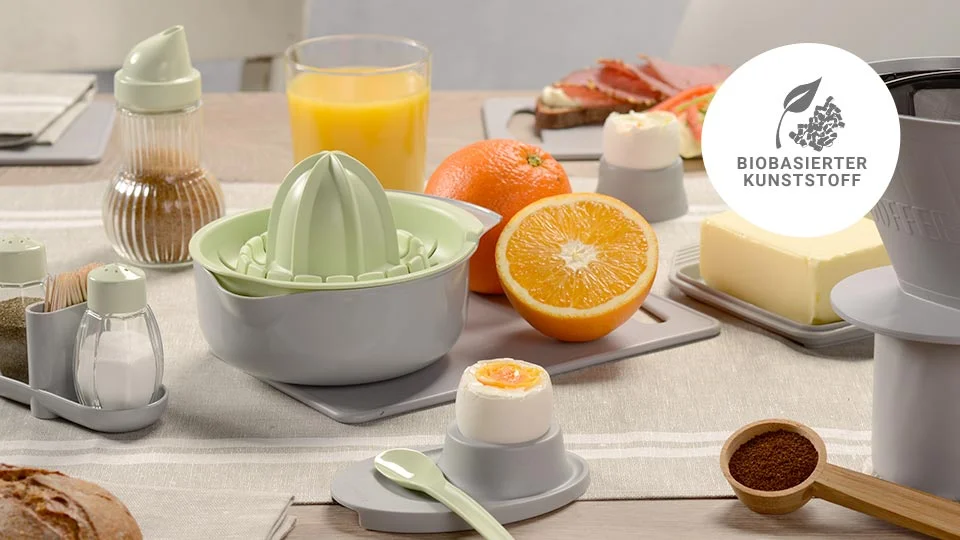
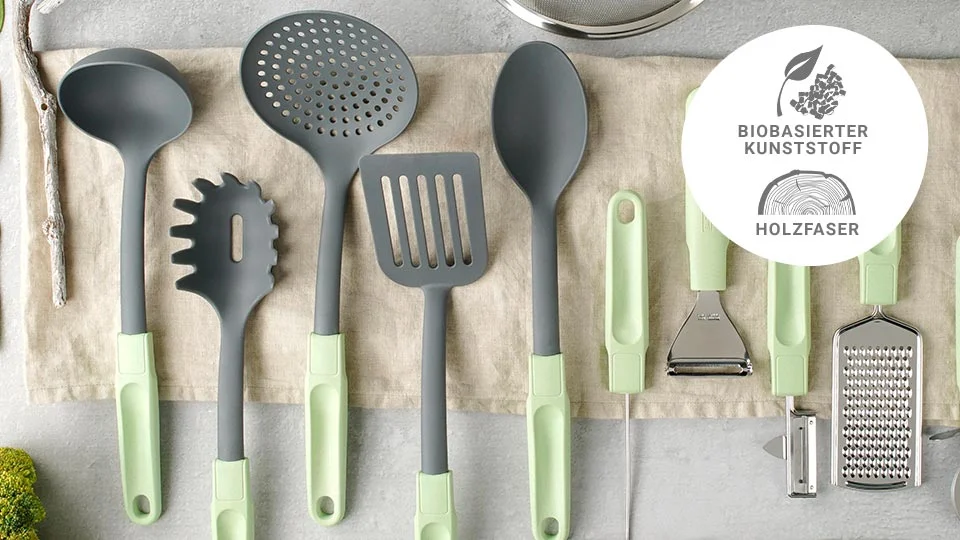
Green PE is a bioplastic made from sugarcane, used for various kitchen utensils. During raw material production, oxygen is released, and the leftover bagasse is converted into energy—often powering sugarcane mills.
In its pure form, Green PE is dishwasher-safe but not heat-resistant, making it ideal for butter dishes, spoons, cutting boards, egg cups, and lemon squeezers.
TO THE RANGE
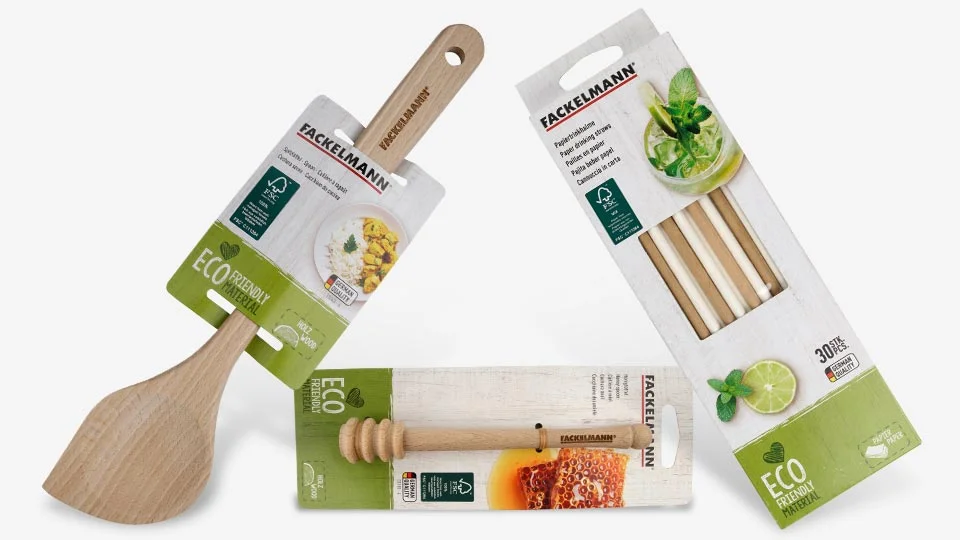
Products in the Ecolution series are made from renewable PE and FSC™-certified wood. They combine natural materials like wood fibers and sugarcane into a durable composite that is dishwasher-safe and highly resistant.

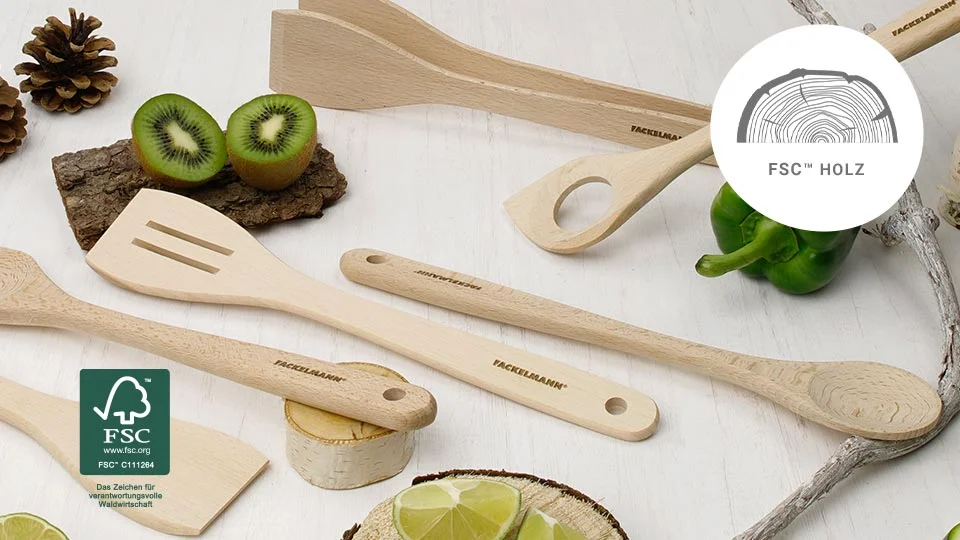
FSC™ (Forest Stewardship Council™) promotes responsible, socially beneficial, and economically viable forest management.
Fackelmann manufactures around 140 FSC™-certified wooden items, including spoons and cutting boards, with more products joining the range. Packaging is also being systematically converted to FSC™-certified materials where possible.
We minimize packaging and avoid unnecessary materials.
TO THE RANGE
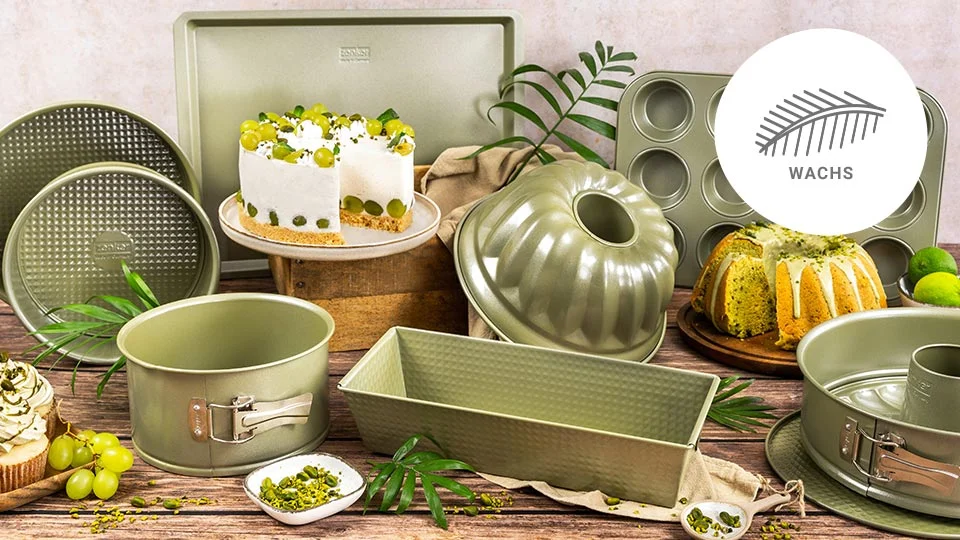
Baking molds require high heat resistance and excellent non-stick properties. We use carnauba palm wax—a vegan, Fairtrade-certified material—as part of the non-stick coating.
Carnauba wax makes up about 5% of the coating, the maximum amount possible without affecting the mold’s performance. These are our first climate-neutral baking molds, available since autumn 2021.

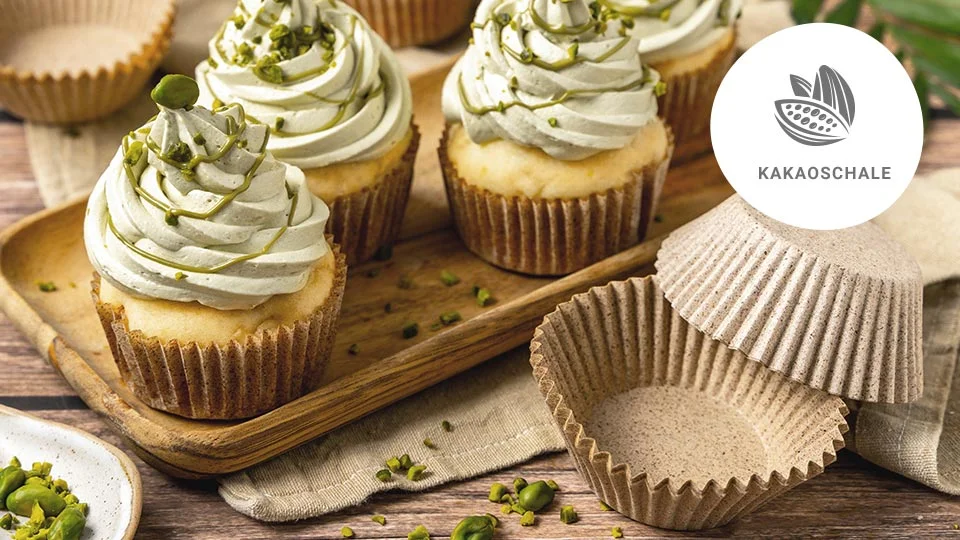
The cocoa bean shell, normally discarded as waste, is processed into organic fibers used in packaging—specifically, muffin paper liners.
By replacing part of the cellulose in paper production with cocoa fibers, we create an innovative, sustainable packaging option. Each piece carries natural variations and patterns unique to the cocoa shell.
TO THE RANGE
We aim to use as little packaging as possible and constantly optimize packaging solutions. For paper and cardboard packaging, we use raw materials that are FSC™ or PEFC-certified or made from recycled materials such as Blue Angel-certified paper. All packaging will be transitioned to these standards by 2025
Through the Fackelmann Children’s Fund, we support regional and international initiatives that benefit children and families in need.